The Host · Part I · Wheat

The Host

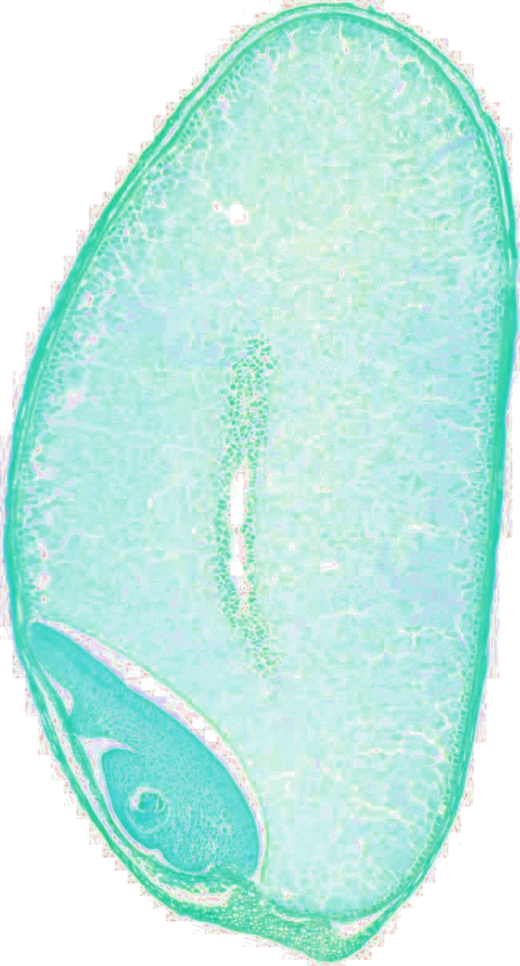
This is one grain of wheat, cut lengthwise, stained, and laid on glass. Everything on this page is made from it and from nothing else.

SpecimenWheat kernel, long section GermThe dense body, upper left BodyEndosperm, the part milled to flour StainRed, as found
A stained thin section of a wheat kernel. The germ is the small dense red body at the upper left of the pale grain.
01 · The process

Flip it, invert it, kill the black.

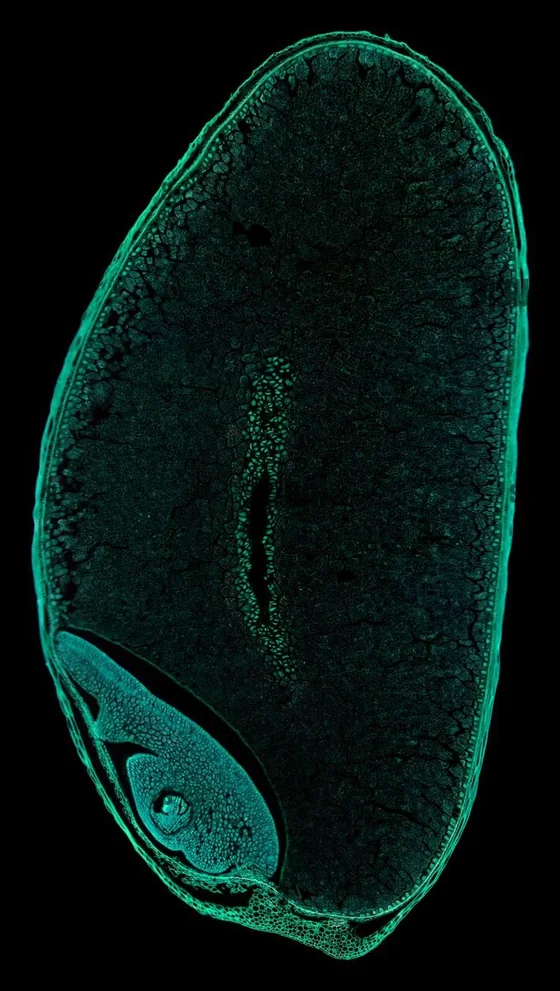
Three moves, in the order they were made. Turned over, the germ drops to the foot of the grain. Inverted, the red stain becomes its opposite and the white glass goes dark. Then the dark is removed and only the color stays.
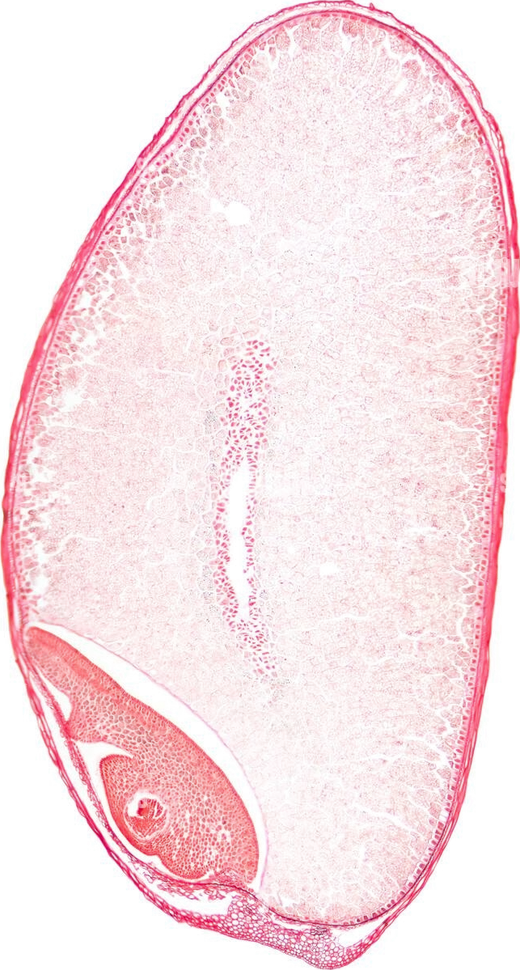
The original red grain, germ at the top.
As found
The grain turned upside down, germ at the bottom.
Flipped
The flipped grain with colors inverted, green on black.
Inverted
The green grain with the black removed.
Black removed
02 · The count

One, twelve, 144,000.

The grain is multiplied only by twelve and by a thousand. Each plate is built from the plate before it. Use the switch above to see every plate in the red stain or its inverse.

Twelve red grains in a ring, germ ends pointing inward. Twelve green grains in a ring, germ ends pointing inward.
12 · Twelve grains in a ring, germ to the center, set like hours.
Twelve rings of twelve red grains, themselves arranged in a ring. Twelve rings of twelve green grains, themselves arranged in a ring.
12 × 12 = 144 · Twelve of those rings, ringed again.
A square of twelve blocks around an open center, each block a field of tiny red grains. A square of twelve blocks around an open center, each block a field of tiny green grains.
12 × 12 × 1,000 = 144,000 · A square with three blocks to a side and an open center. Each block holds twelve fields of a thousand.
Close view of the fields: rows of tiny red grains. Close view of the fields: rows of tiny green grains.
Detail · One corner at full size. Every mark is a whole grain.
03 · The measure

Around is never a whole number of across.

Now the grain is a ruler. Lay grains end to end around a shape, then straight across it. Six around takes exactly two across. From twelve onward the last grain across is always cut short.

Six red grains on the sides of a hexagon with two grains across its middle. Six green grains on the sides of a hexagon with two grains across its middle.
6 around, 2 across · The ratio is exactly 3.
Twelve red grains around, with four across the middle, the fourth cut off. Twelve green grains around, with four across the middle, the fourth cut off.
12 around, 3.86 across · The fourth grain does not fit.
Five nested rings of 6, 12, 24, 48 and 96 red grains sharing one line of grains across the center. Five nested rings of 6, 12, 24, 48 and 96 green grains sharing one line of grains across the center.
6, 12, 24, 48, 96 · Doubling the count each time, with one line across for all five rings.
Rows of red grains: two across at the top, then rings of 6, 12, 24, 48 and 96 cut open and laid flat, each a little longer than the last. Rows of green grains: two across at the top, then rings of 6, 12, 24, 48 and 96 cut open and laid flat, each a little longer than the last.
Unrolled · Top row is the distance across. Below it, each ring cut open and laid flat against the same distance. Watch the right edge.
Grains aroundGrains acrossAround ÷ across
62.003.0000
123.863.1058
247.663.1326
4815.293.1394
9630.563.1410
a circle3.1416